

What to Expect on Thai Roads as A Big Bike Rider
If you’re visiting Thailand for the first time and about to hop on a big bike, we’ve got your back! Here’s what we tell every rider before they roll out.
Experienced riders usually find Thai roads easier than they expected, and stranger than they were told. The surfaces are mostly fine and the drivers are mostly patient. What’s new is the rhythm: scooters everywhere, local habits that skip the textbook, and roads that change character every few hundred kilometres.
The quick version: Thai traffic is slow, mixed and mostly on two wheels, so your big bike is faster than everything around it. Most trouble comes from that speed gap, from sand, oil and unlit vehicles, and from the hours around dusk. Read the road early, keep your speed inside what you can see, and finish the day before dark.
How Thai traffic works
In one lane you might meet a scooter at 20 km/h, a truck at 60 and you at 80.Your big bike is usually the fastest thing on the road, so you’ll catch up to scooters and trucks quicker than you expect. The good news? Thai drivers are mostly patient and easygoing. Just look far ahead, ease off early, and you’ll glide through smoothly.
Read the scooters, not the indicators.
Most riders rarely signal, so let their bodies do the talking. Watch the front wheel and the rider’s head: a quick look over the shoulder usually means they’re about to move, and a turning wheel shows where they’re going before the bike does.
Don’t assume they’ve seen you, even with your headlight on. A scooter pulling out of a side street may only be looking for cars, so ease off near side streets, driveways and petrol stations. Give extra room to scooters carrying kids or big loads, since they tend to drift and stop suddenly, and expect someone to slip through any gap between vehicles.
A short beep means “I’m here.” A headlight flash from behind means “I’m coming through,” so hold your line and let them pass.
Watch the shoulders and U-turn gaps.
Wide paved shoulders work as an extra lane for slow scooters, parked pickups and street stalls, and some locals ride against traffic along them. On divided roads, vehicles slow suddenly at median U-turn gaps, so keep your eyes on both sides ahead.
Roads and tips
City and towns
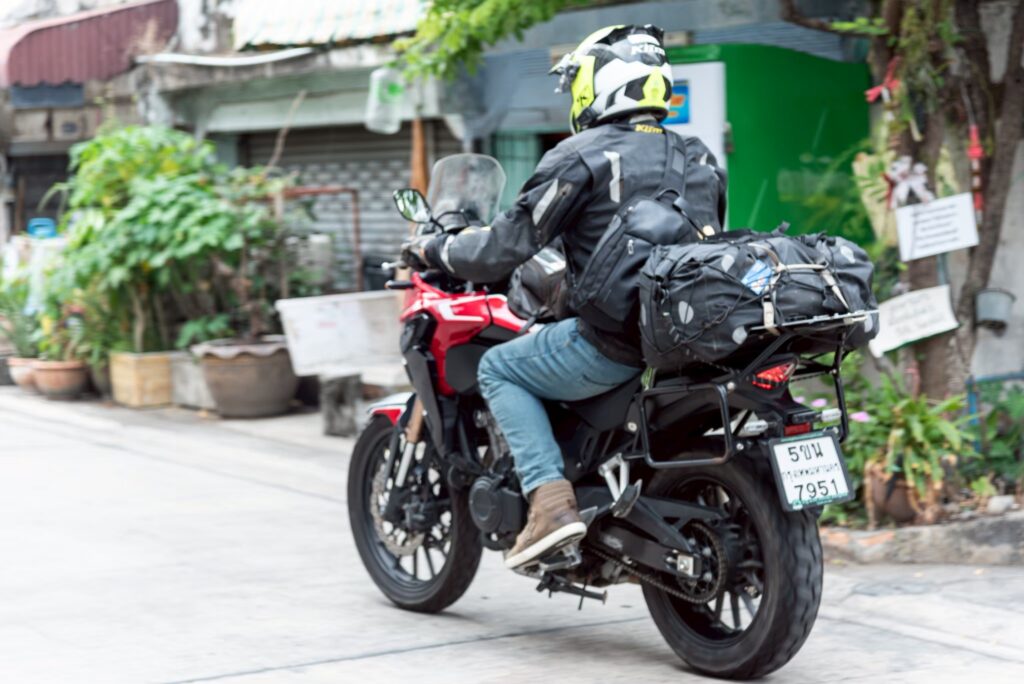
Slow riding is the real test here, not fast riding. U-turns, car parks and stop-and-go traffic show off a heavy bike’s weight, and panniers make you wider than the gap a scooter just squeezed through. Many riders find the busiest part of a trip is the approach to a big town, not the mountains beyond it. Motorcycles aren’t allowed on tollways, so set your map app to avoid them.
Highways and countryside
Speeds are higher and the mix is wider, with farm pickups that stop or turn without warning, sidecar bikes, and dogs on the verge. Long straight roads make it easy to cruise faster than your headlight or reaction time suits, so keep your speed inside your light.
Mountains
The Mae Hong Son Loop is famous for its 1,864 curves, and November to February is the best season. Cool mornings matter more than they sound. Cold tyres and damp painted lines give less grip, and mist can hang in the valleys until mid-morning. Warm up your tyres gently, expect gravel on bends in the dry season, and remember there’s no street lighting and slow trucks climb on blind corners. On long descents a heavy bike’s brakes heat up, so lean on engine braking and keep the pace relaxed.
Sand collects on bends beside the beach, and the first rain after a dry spell lifts oil to the surface. Slow down early and gently, and park on firm ground, because a side stand can sink in soft earth. Beach hubs are full of first-time scooter riders, especially in the evening.
Dogs, sidecar bikes and unlit vehicles
They’re part of daily life in Thailand, and after sunset they like to rest on warm tarmac, right when they’re hardest to see. If one runs alongside you, ease off, hold your line and let it drop back. Swerving is usually worse than the dog.
Sidecar bikes, tractors and older pickups
Sidecar bikes (rot puang kang to many Thai people, saleng to many foreigners) may show a dim light, a tiny reflector or nothing at all after dusk. The danger is simple arithmetic. At 70 km/h behind a sidecar bike doing 15, you’re closing at about 15 metres every second. If you first spot it from 40 metres away, you have under three seconds.
Ease off at the first small red light or odd shape, leave a generous gap, and pass only when you can see clearly.
In the official figures for the first two days of the 2025-26 New Year road safety campaign, the busiest time for accidents was between 6 and 9 pm. Dusk, headlights, tiredness and busy roads all show up at once. Your headlight also shows less road than you might think, especially at higher speeds or with luggage on the back. Our simplest habit is to plan the day backwards from sunset, arrive an hour before it, and treat the evening as dinner.
Looking after your rental
Most rental drops happen slowly: in car parks, on U-turns, and when pulling away on soft or sloping ground.
- Give a new bike a calm first hour.
- Park on firm, level ground.
- Check tyres, brakes, lights and chain each morning.
- Stop and drink when you’re stuck in slow traffic, since heat builds fast.
Damage and theft are the renter’s responsibility, so our insurance guide is worth a read, and our Pickup Day Checklist covers that first hour.
Planning a holiday ride?
Thailand runs a national road safety campaign over holidays with more checkpoints and heavy traffic. Carry your licence, International Driving Permit and passport copy, allow extra time on return days, and book early since it’s our busiest time too.